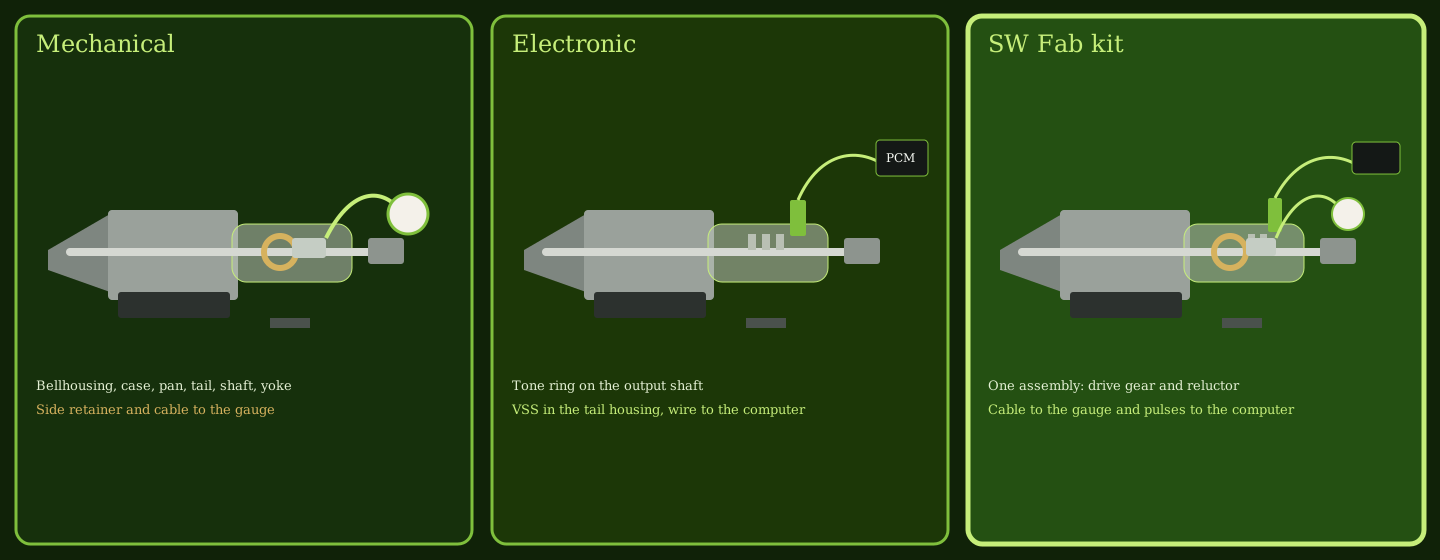
One simplified automatic, three ways the output shaft can report speed: a cable, a sensor, or both at once.
By Southwest Fabrication, Caddo Mills, Texas ·
Short answer
A mechanical drive uses gears and a cable. An electronic drive uses a toothed ring and a sensor. The SW Fab kit puts both jobs on one assembly on the output shaft, so a mechanical gauge can stay and the computer still gets a speed signal.
Look at all three
Drag to look around. Pinch or scroll to zoom. Hover or tap a part to name it. The slider only speeds the picture up. It is not a miles-per-hour reading.
Mechanical
Inside the tail housing, a drive gear on the output shaft turns a driven gear. That gear sits in a retainer that enters the side of the housing and spins the cable out to the gauge.
Electronic
Same transmission. A toothed ring rides the output shaft, and a vehicle speed sensor threads into the tail housing. Each tooth makes a pulse on the wire to the computer, and the gauge follows.
The SW Fab kit
Mechanical and electronic
One assembly on the output shaft is both the speedometer drive gear and the toothed reluctor. It turns the cable for a mechanical gauge and still sends pulses to the computer.
A simplified 4L60E/4L80E-style automatic, not a measured drawing. The tail housing stays see-through so the shaft shows. X-ray fades the rest of the case. Full transmission and Close-up move the camera. Explode pulls the pieces apart.
Why an LS swap customer picks a mechanical kit
The electronic overdrive in a typical LS swap was built without a cable. The original speedometer in an older car was built with one. Leave it like that and the needle sits on the peg.
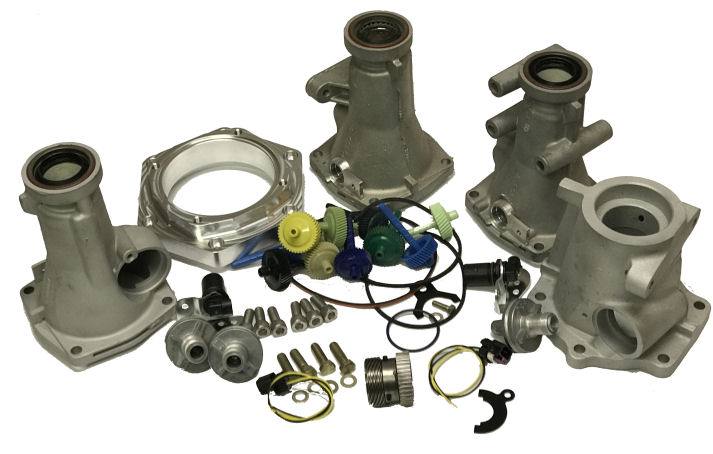
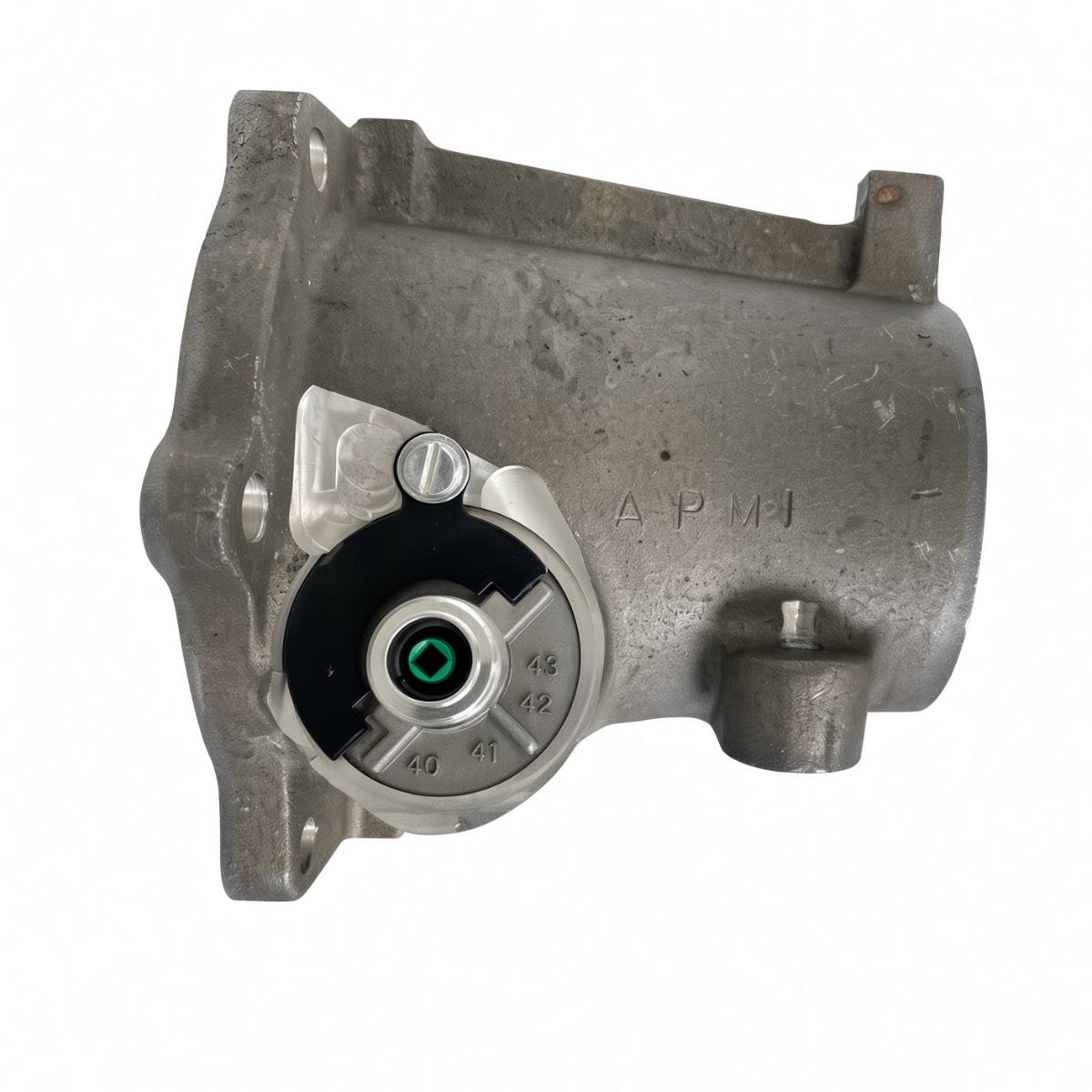
The third picture is that kit. One assembly on the output shaft drives the mechanical cable and the toothed ring the sensor reads, so the factory gauge can stay in the dash and the computer still gets a speed signal. The gears are cut for your tire and rear gear. If the combination is odd, call 469-688-6985 and the shop will cut it to suit.